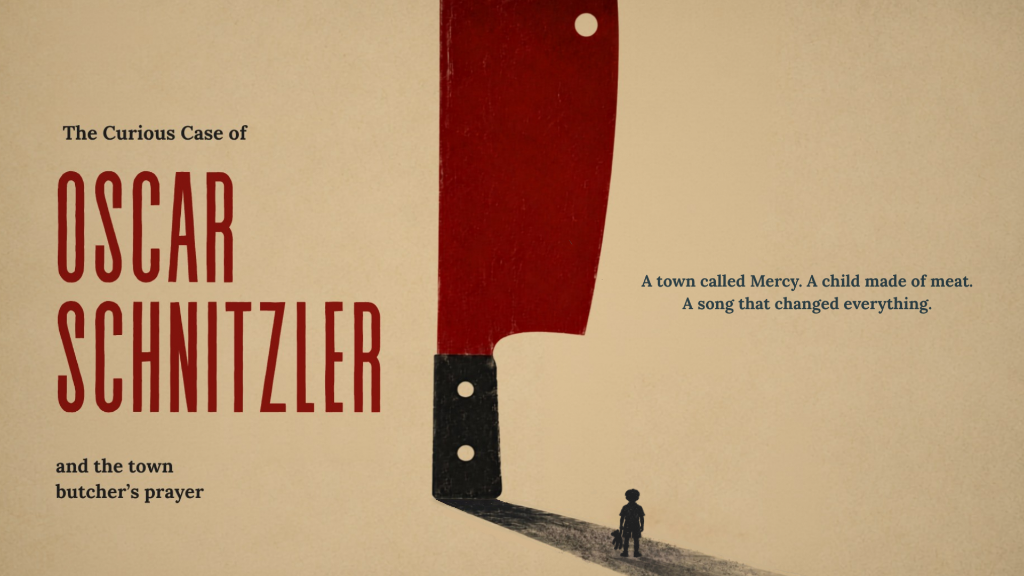
The Curious Case of
Oscar
Schnitzler
And the Town
Butcher’s Prayer
“A town can tolerate a six-year-old boy made entirely of meat.
What it cannot tolerate is the way he speaks.”
In 1957, an ageing butcher and his wife pray for a child and awaken to Oscar, a six-year-old boy made entirely of meat. When Mercy’s respectable prejudice hardens into organised persecution, Oscar discovers that the strange sounds everyone fears are music – and risks taking the stage before the town can silence him for good.
The next voice the film needs.
The feature screenplay is complete and in advanced development. John Stephenson OBE is attached to direct. The film’s visual world has been extensively developed and the original musical architecture is in place.
The project is now seeking an experienced lead feature producer/production partner to join at the point where creative development becomes packaging: to challenge and refine the production model, establish the line budget and schedule, build the cast and sales package, shape the UK/international finance plan and take the film into the marketplace.
This is not an invitation to execute a predetermined production plan. It is an invitation to help build the definitive one.
A history that doesn’t stay in the past
Mercy is fictional, but the racial order surrounding it is not. Set in a small American town in 1957, the film unfolds at a moment when legal change was colliding with entrenched segregation, local power and generations of social custom. Hollow Road exists physically close to Mercy while being deliberately excluded from its civic, economic and social life.
The screenplay does not equate Oscar’s difference with Black experience. Instead, placing those experiences beside one another exposes the different mechanisms by which communities decide who belongs, who is tolerated, who is feared – and who is forced to carry the consequences of somebody else’s prejudice.
Respectability as violence
The people of Mercy rarely think of themselves as cruel. They think of themselves as decent. That is what makes them dangerous.
The film is interested in prejudice expressed not only through open hatred but through politeness, institutions, gossip, religion, silence and the instinct to preserve an existing order at somebody else’s expense.
The human story
Although the story belongs specifically to 1957 America, its central behaviour remains recognisable: communities still decide who sounds right, looks right, belongs naturally and should be expected to adapt.
Beneath the politics is something extremely simple: two ageing people desperately want a child. They promise to love whoever arrives. What follows tests whether a family can keep that promise when the world around them cannot.
Mercy, 1957. Three acts. One impossible child.
A prayer answered
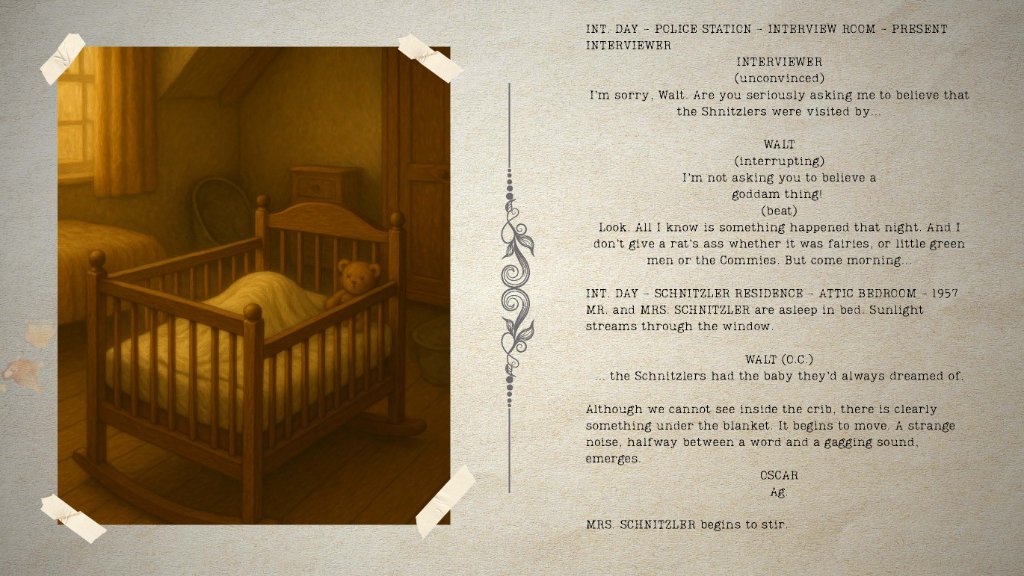
Mercy keeps its rot beneath the peppermint. In a town built on appearances, the ageing Schnitzlers pray for the one thing life has denied them: a child. That night, a peach-purple orb rises impossibly from their kitchen sink, slips into the butcher’s refrigerator and brings the meat inside to life. By morning, their prayer has been answered. In the crib lies Oscar – a child of six or seven, made entirely of butcher’s trim, watching the world with curious intelligence, and able to say only one thing: “Ag.”
The town turns
Oscar settles into Mercy as a gentle, curious child with music already stirring inside him. But curiosity curdles into gossip, gossip into moral panic, and moral panic into a creed. Drawn beyond the town’s narrow boundaries, Oscar finds Hollow Road – and, in Ada Mae Watkins and Young Jim, the first people outside his family who meet him without fear. There he discovers that music can do more than entertain: it can shelter, communicate, gather people together – and, when necessary, defy the world beyond the door.
The concert
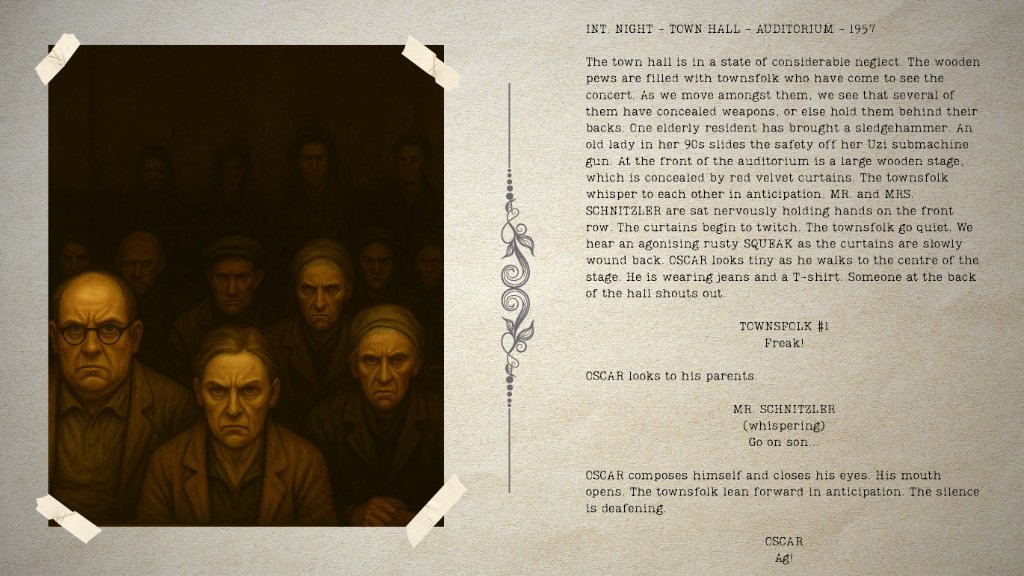
As Mercy’s fear hardens into open persecution, Oscar refuses to abandon the concert and walks onto the Town Hall stage by choice. Before an audience that has come ready for violence, the music he has always carried finally finds words, exposing the secrets, hypocrisies and buried desires of those who judged him. What begins as spectacle becomes reckoning. Hollow Road arrives not for revenge but to bring Oscar home. Nothing is neatly forgiven. But the old divisions have shifted – and, for once, Mercy must adjust around Oscar rather than asking Oscar to adjust to it.
The miracle that began in the Schnitzlers’ kitchen reaches its final expression in the Town Hall. Oscar has spent the film being watched, judged and asked to become something easier for Mercy to understand. Now the music he has carried inside him finally fills the room – and, for once, it is everyone else who must learn to listen.
Hollow Road does not offer Mercy an easy absolution. “Songs are easy. Morning’s harder,” Ada Mae reminds them. The two communities sing beside one another, but not as one: Hollow Road asks them to “Leave a Little Light On”; Mercy answers, “Let a Little Light In.” Their voices remain distinct. Then Oscar begins to hum, and the room adjusts around him.
Mercy is not healed by a song. Not reconciled. Not forgiven. But no longer separated by the aisle. And somewhere in the quiet that follows, Oscar slips away. The impossible child who arrived without explanation leaves in much the same way. From somewhere beyond the room comes one final, familiar sound:
Ag –

Character study · Oscar Schnitzler
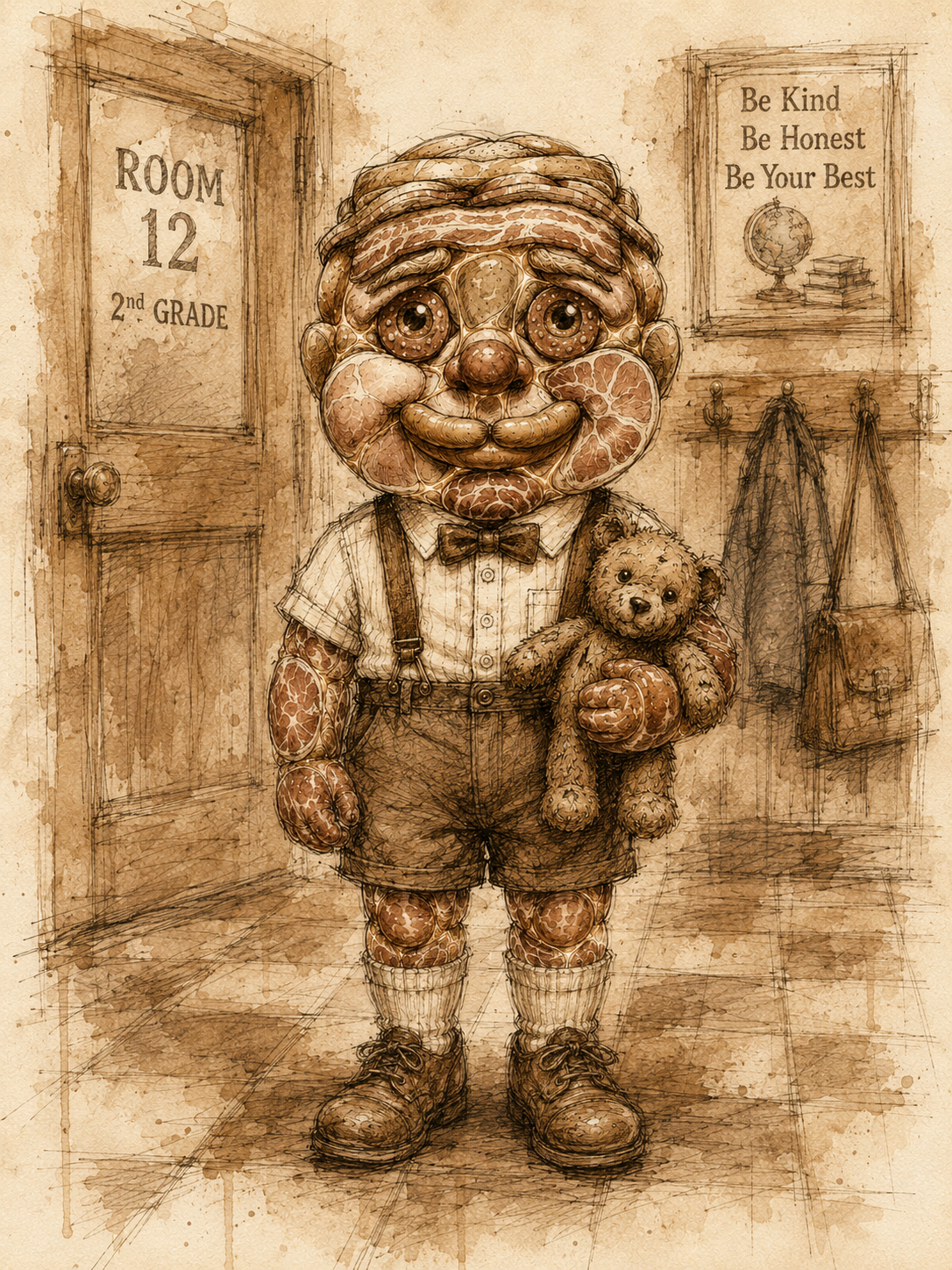
Scene study · Oscar at school
A boy of six or seven, made entirely of meat.
He arrives fully formed – a small child of six or seven, cut from the butcher’s counter and bound by magic no one in Mercy can explain. He is gentle, curious, overjoyed to simply exist. And the only word he can say is “Ag.”
Mercy hears a child whose language it does not recognise – and stops listening. The town is wrong. Oscar has always had a language; it lives in rhythm and sound, and no one in Mercy thinks to look for it. At the concert he begins by humming. No one taught him the hum. It is entirely his own. Then the Orb pulses – and for the first time his music carries words. Not speech. Song.
During the climactic number his singing voice becomes a rich, youthful baritone with a velvet warmth, a lazy Southern curl and an instinctive rock ’n’ roll swagger far too large for his small frame.
Oscar already had a voice. The light only let him sing it.
The postcard and the rot
A picture-perfect 1950s American town whose charm is a façade. White steeples, screened porches, peppermint and Sunday best – maintained with a practised, quiet cruelty. Mercy recognises violence only when it stops being polite.
Dignity, faith and song
The Black community Mercy has pushed to its margins: poor, close-knit, musical and governed by the hard knowledge that courage has consequences. It gives Oscar something Mercy has denied him – ordinary welcome – but helping him eventually places the community in genuine danger. Hollow Road recognises the mechanism being used against Oscar because its residents already understand exclusion, surveillance and unequal treatment – and the cost of resistance.
Ada Mae and Elijah disagree over what responsibility requires when protecting one child may expose dozens of others. Hollow Road carries its own conflicts, obligations and fears; it is not a moral chorus standing conveniently outside the story.
The film’s world is shaped by the collision between these two places – one knows that belonging begins with making room; the other has built its identity around deciding who belongs.
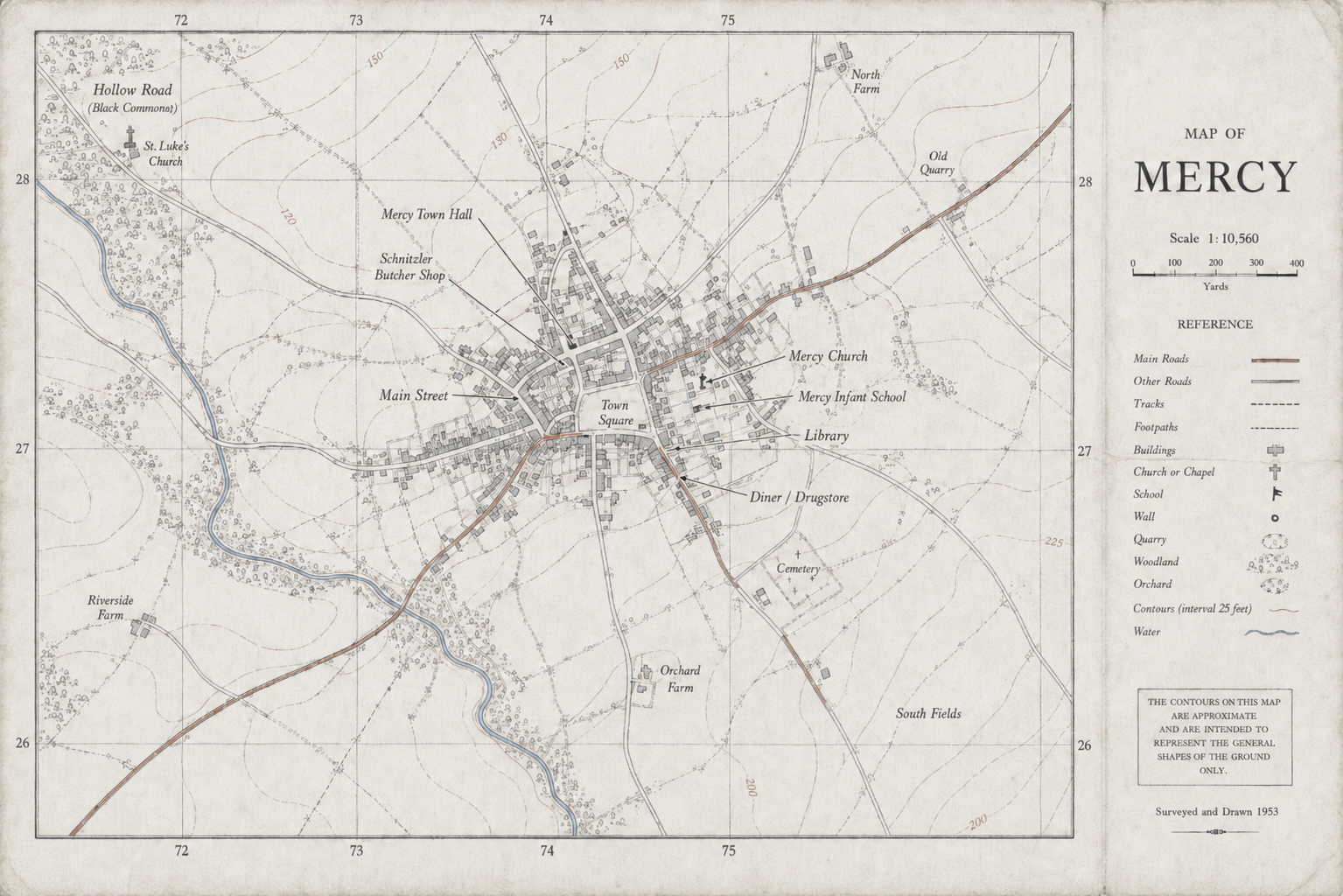
Visual-development map · Mercy · c.1957
Alongside Oscar, the screenplay contains several substantial adult roles with meaningful packaging potential, including Walt Kennedy, the Schnitzlers, Ada Mae Watkins, Deacon Pritchard and Margery Hale.
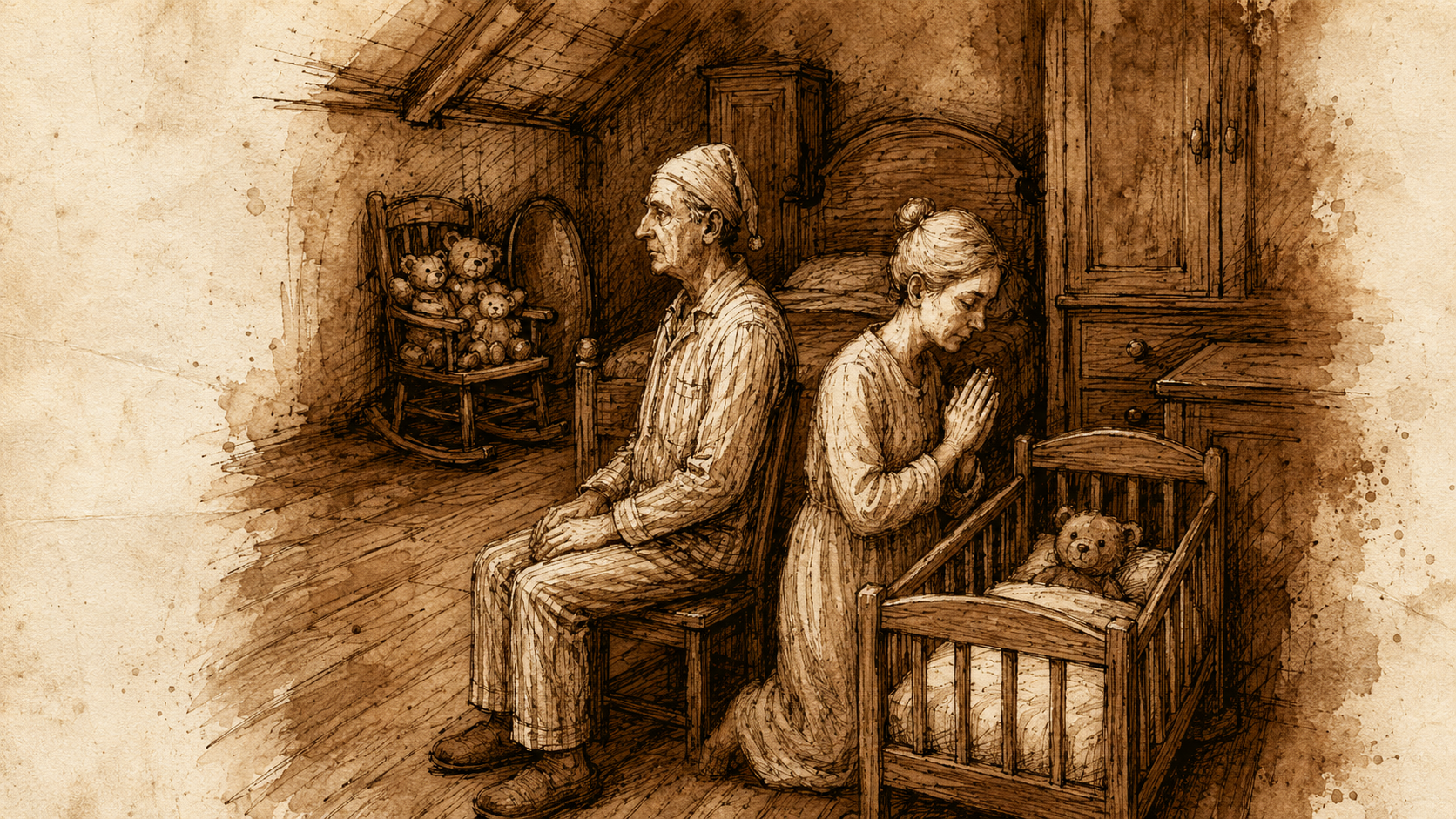
The Schnitzlers
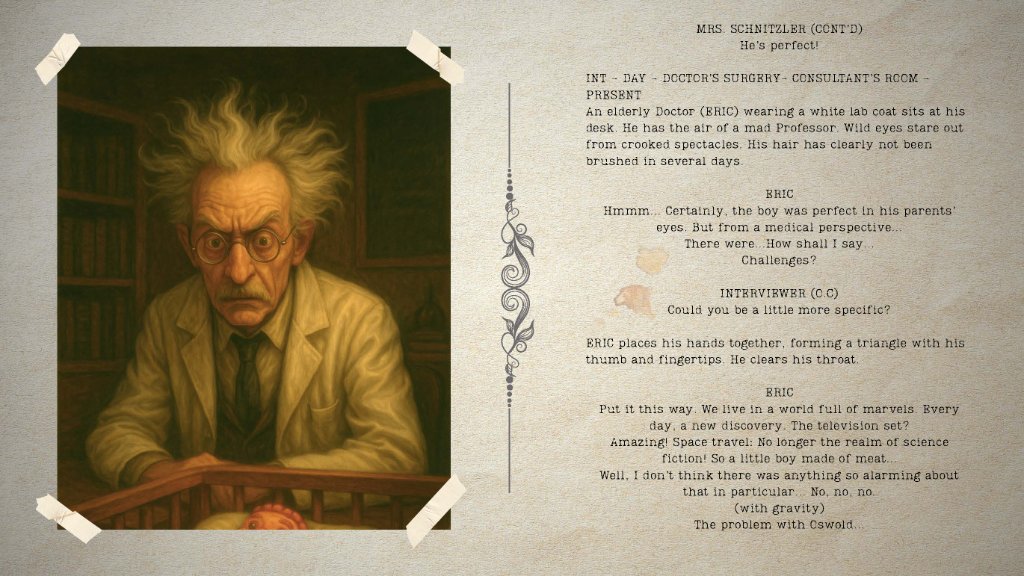
An ageing butcher and his wife whose lifelong prayer for a child is answered by a boy made of meat. Their love is immediate and unconditional; what is tested is whether it survives once the town makes that love socially impossible. They are the film’s emotional ground – private devotion placed under public pressure.
He’s... perfect!

A career built around making the impossible emotionally real.
Oscar Schnitzler needs a director who understands that creature work is ultimately performance, not spectacle. John Stephenson’s career is unusually aligned with that challenge. He joined the Jim Henson organisation as The Dark Crystal was beginning, rose to lead the Creature Shop, and spent the following years working across puppetry, animatronics, creature effects and visual effects before moving fully into directing. The common thread is not technology for its own sake, but the ability to make something physically impossible behave, react and feel like a living character.
That distinction is fundamental to Oscar. The audience has to register the absurdity of a child made from butcher’s meat and then, very quickly, stop treating him as an effect. His face must think. His body must hesitate, play, recoil, dance and communicate. The success of the character will not be measured by how elaborate the mechanism is, but by how completely the mechanism disappears behind a six-or-seven-year-old boy.
John Stephenson’s Creature Shop career included work across productions such as The StoryTeller, The Witches, The Muppet Christmas Carol, The Flintstones, Babe, The English Patient and Lost in Space. He was also a co-recipient of an Academy Scientific and Engineering Award for the Henson Performance Control System – technology developed around the principle that complex mechanical characters should respond to a performer with immediacy and emotional nuance. For Oscar, the relevance is philosophical as much as technical: the creature succeeds when the audience sees the performance before it sees the machinery.
He has already carried that understanding into the director’s chair. Animal Farm combined live animals with sophisticated animatronic characters to make Orwell’s political allegory function as drama rather than effects demonstration; Five Children and It placed an impossible creature at the centre of a live-action family story. Both demanded the same essential negotiation that Oscar requires – allowing fantasy, physical effects, actors and emotion to occupy the same frame without one overwhelming the others.
His later work broadens that relevance. Interlude in Prague, which John Stephenson co-wrote and directed, brought together period filmmaking, music, performance and heightened theatricality in an eighteenth-century setting. That experience matters to a film which must move confidently from intimate family drama and social realism into musical spectacle without feeling as though it has changed into a different movie.
For Oscar, John Stephenson therefore brings more than an effects pedigree. He brings decades spent at the point where design becomes performance, performance becomes character, and technical illusion becomes emotional truth. The aim is not to persuade an audience that a boy made of meat could exist. It is to make them care so deeply about Oscar that, eventually, the question stops mattering.
Former leader of Jim Henson’s Creature Shop, with deep experience across puppetry, animatronics, creature effects and visual effects – grounded in the principle that technique exists to serve performance.
Director of Animal Farm and Five Children and It – films in which non-human and fantastical characters had to function as emotionally credible participants in live-action drama.
Co-recipient of an Academy Scientific and Engineering Award for the Henson Performance Control System, developed to translate human performance into expressive character movement in real time.
Co-writer and director of Interlude in Prague, combining period filmmaking, dramatic performance, music and heightened theatricality – experience directly relevant to the film’s 1957 world and musical storytelling.
With Oscar, the effect succeeds only when the audience stops seeing the effect.
Six numbers, two reprises
Six original musical numbers span dirty rockabilly, a heartbreaking duet, dark gospel, a villain’s civic hymn and Oscar’s defiant solo – with two reprises that close the film. All six demos are playable below.
The town exposes its own hypocrisy – narrated through Walt’s cynical lens.
Development demo · may contain earlier lyric variationsThe Schnitzlers pray for the child they never had - the film’s emotional genesis.
Development demo · may contain earlier lyric variationsGossip becomes public hatred – the town’s fear crystallises into a mob anthem.
Development demo · may contain earlier lyric variationsHollow Road’s hope song – Ada Mae teaches Oscar that music can be shelter.
Development demo · may contain earlier lyric variationsDeacon Pritchard weaponises the town's decency into a mob's creed.
Development demo · may contain earlier lyric variationsThe dramatic and musical climax, when Oscar’s existing music is supernaturally allowed to carry words.
Development demo · may contain earlier lyric variationsLyrics · All original lyrics are written by Thomas Craig.
Canonical text · The lyric sheets reproduced in the appendix are the current locked screenplay lyrics. Development demos may contain earlier lyric variations; the locked screenplay is authoritative.
Music/Composition · To be confirmed/formalised with producer and music team.
Demo Status · Development demos completed for all six original musical numbers. Development music demos are illustrative pre-production materials and do not constitute the final commissioned score or final soundtrack recordings.
Rights Status · To be confirmed/formalised with producer and music team.
A picture-perfect 1950s American town whose postcard charm gradually reveals itself as a façade – then increasingly staged, watchful and oppressive.
Heightened Americana grounded in tactile realism: painted signs, Formica, faded wallpaper, butcher paper, practical neon, worn timber and ageing civic interiors. Stylised, but never weightless.
Mercy’s public face is powder blue, mint, butter yellow, ivory, cherry red and confectionery pink – disturbing through repetition and excessive neatness. Tobacco brown, mould green and nicotine yellow suggest the rot beneath.
Early compositions are symmetrical, elegant and controlled. As fear grows, framing becomes claustrophobic: faces through windows, curtains dividing the image, townspeople arranged in rigid groups.
Songs grow organically from the physical world. Rooms transform through practical, theatrical changes – furniture shifts, lighting isolates performers, ordinary gestures become choreography.
Oscar is a tactile practical creation – strange but emotionally approachable, photographed with tenderness. The peach-purple orb is the film’s only overt supernatural light source: warm, curious, responsive to music.
Visual References
Practical-first creature strategy.
Oscar is conceived primarily as an in-camera character: physical construction, puppetry/performance engineering and tactile interaction with cast and environment wherever dramatically credible. Digital work supports rather than replaces the performance – removing rigs, extending movement and solving shots where physical methodology reaches its limits.
A body in the room
Oscar has to occupy physical space, interact with actors, take light, move, wobble and dance. He cannot feel like a generic VFX invention.
Performance engineering
Puppetry, animatronics and suit work let a performer’s movement read as feeling in real time – the lineage John Stephenson built his career on.
Digital support
CGI removes rigs, extends movement and solves shots where physical methodology reaches its limits – supporting, not replacing, the in-camera performance.
Oscar development path
The next major visual-development milestone is not more concept art but proving Oscar as a moving screen performance.
- 01Character maquette / material tests
- 02Facial and eye-expression test
- 03Movement / gait / sitting / running tests
- 04Human-contact tests – held, hugged, threatened, dancing
- 05Camera / lighting tests
- 0660–90 second practical performance proof-of-concept
Contemporary creative & audience references
No single film is a direct analogue. Together, these six locate the unusual territory the film occupies.
Creative/audience references – not financial compsSinners
2025Music, race and supernatural genre sharing the same period-American bloodstream.
A contemporary demonstration that period history, Black community life, music, humour, horror and supernatural genre can coexist within one unapologetically authored film.
A Different Man
2024Visible difference exposing the assumptions of those doing the looking.
A darkly comic exploration of how appearance, acceptance and social judgement often reveal more about the observer than the person being observed.
Poor Things
2023Grotesque physical invention treated with absolute visual conviction and emotional seriousness.
A contemporary example of an impossible created human being existing inside an unapologetically heightened world while grotesquerie, humour, social satire and genuine emotion coexist.
Asteroid City
2023The immaculate American postcard rendered strange enough for the seams to show.
A useful visual-world reference for Mercy: highly controlled 1950s Americana, saturated civic order and postcard imagery disrupted by the arrival of something impossible.
Guillermo del Toro's Pinocchio
2022An impossible child, a parent’s promise and a dark fable that refuses to explain away its miracle.
A useful conceptual relative: an impossible child enters the life of an older parent, love is tested by the reality of who that child actually is, and music operates inside a dark, handcrafted fable.
Annette
2021An adult musical asking an overtly artificial child to carry genuine dramatic weight.
Particularly relevant to Oscar’s physical-performance challenge: an openly artificial child exists alongside live performers while the film expects the audience to move beyond the mechanism and engage emotionally.
Creative DNA/Lineage
The Cinematic Traditions the Film InheritsThese are not direct comparables. They are the cinematic traditions the film inherits: American Gothic, dark musical form, the artificial outsider, vernacular Americana, corrupted small-town idealism and emotionally credible creature performance.
The Night of the Hunter
1955American Gothic rendered as a dark fairytale – a small-town community held in the grip of a preacher’s appetite, where the monstrous and the sacred wear the same face.
Little Shop of Horrors
1986A comically impossible plant engineered from practical puppetry, asking the audience to invest in – and laugh at – something grotesquely alive inside a musical number.
Edward Scissorhands
1990An artificially made figure with a tender interior brings wonder and then destruction to a pastel suburban community that cannot hold what it does not understand.
O Brother, Where Art Thou?
2000A vernacular American landscape built from old-time music, period-postcard imagery and tall-tale structure; music as the connective tissue of a whole world.
Pleasantville
1998A pristine, self-satisfied American idyll corrupted and deepened by contact with what it excluded – the postcard ideal made strange by feeling it cannot contain.
The Shape of Water
2017An impossible creature treated with such tactile and emotional seriousness that the audience moves past the mechanism into genuine feeling – the lineage of how Oscar will ask to be held.
The Curious Case of Oscar Schnitzler and the Town Butcher’s Prayer has ancestors. It does not have a twin.
The film does not sit neatly inside any one of these films. Its opportunity lies in the space between them: the emotional architecture of a dark fable, the audacity of an adult musical, the tactile presence of a creature performance and the social pressure of 1957 America.
Audience
Adult audiences seeking distinctive auteur-led genre, dark comedy, elevated horror/fantasy and cult musical cinema.
Audiences drawn to outsider narratives, practical creature filmmaking, heightened period worlds and original soundtrack-driven films.
Music, creature design, quotable characters and a visually iconic protagonist create potential for repeat engagement beyond first-window viewing.
A child born different into a town that polices how bodies should look, speak and belong. The film may have strong resonance with queer audiences around visibility, conformity, chosen family and the pressure to hide difference.
Market positioning
Ambition: premium independent theatrical/specialty genre crossover with festival-launch potential. Festival and awards strategy to be developed with the lead producer, sales agent and eventual distributor according to completion timing, premiere requirements and market conditions.
Underlying screenplay and lyric rights are controlled by the writer, subject to final production legal review and chain-of-title documentation. Chain-of-title and third-party rights documentation will be consolidated during producer-led packaging.
Not a locked production budget. To be validated with the lead producer, line producer and production accountant through professional scheduling and line budgeting.
Potential BFI Impact Feature Funding route, subject to full eligibility, dedicated lead-producer attachment, sales-agent engagement, third-party finance, final budget and application requirements. Current BFI Impact guidelines require a dedicated lead producer who is not the writer or director.
The production intends to develop Hollow Road and the film’s 1957 historical context with appropriate Black American historical, cultural and musical collaborators/consultants as the team expands. No unconfirmed consultant attachment is implied.
The Writer Behind Oscar
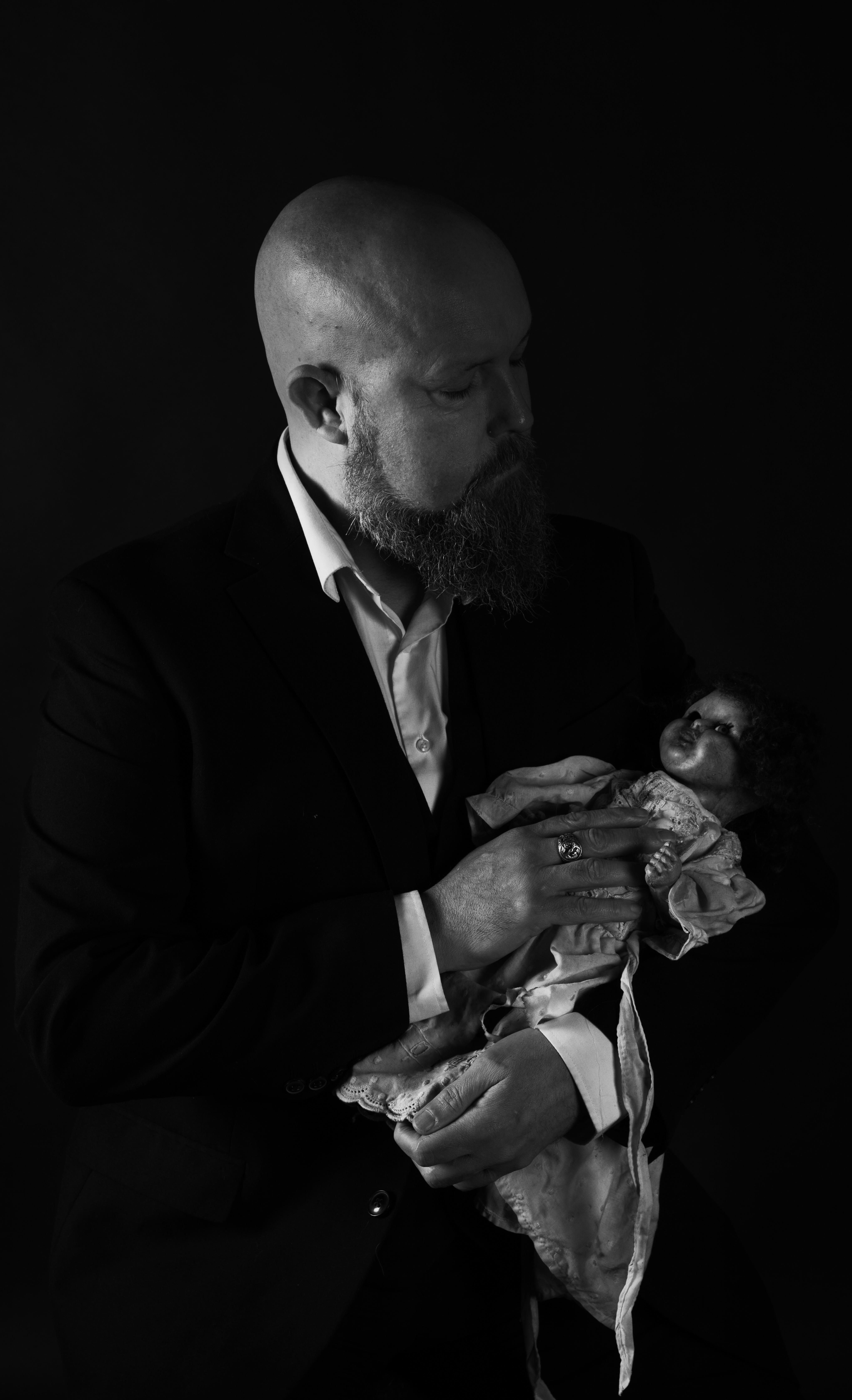
Thomas Craig has taken The Curious Case of Oscar Schnitzler and the Town Butcher’s Prayer from a deliberately improbable premise – a child made entirely of meat – to a complete feature screenplay with six original musical numbers and two reprises. He has shaped the story, lyric voice, visual development and practical approach around one central test: Oscar must feel like a child before he feels like a concept.
That demands unusually fine tonal control. The film has to be funny without making Oscar the joke; strange without becoming grotesque; emotionally open without becoming sentimental. It moves between dark comedy, family drama, racial violence, supernatural fable and musical spectacle, but always returns to the same emotional truth: Oscar is not the character who needs fixing. The world around him has to learn how to listen.
Thomas Craig’s experience across screenwriting, producing, script development, consultancy and film-finance assessment has shaped the project with production in mind. The period world, practical creature lead, original music and large-scale finale are treated not simply as ambitions on the page, but as interlocking creative and production challenges that will ultimately be solved with the right filmmaking partners.
As writer and associate producer, Thomas Craig’s role is not to lock every subsequent decision in place. It is to protect the qualities that make the film singular – its central character, tonal confidence, humour, emotional intelligence and refusal to simplify its themes – while inviting an experienced lead producer to challenge, sharpen and materially shape the route from screenplay to screen.
“[Thomas Craig] has a keen eye for script writing and an encyclopaedic knowledge of film.”
Writer of the feature screenplay and lyrics for all six original musical numbers and two reprises, and originator of the project’s creative and visual-development direction.
Experience across screenwriting, producing, script development, consultancy and film-finance assessment brings practical production awareness to an unusually ambitious project.
An associate producer seeking an experienced lead producer with genuine influence over packaging, casting, budget, schedule, finance, production strategy and the route to the screen.
The Curious Case of Oscar Schnitzler and the Town Butcher’s Prayer already has a clear authorial centre. What it needs now is the producing partner who can help turn that vision into a film.
Let’s build the film.
The creative foundation is in place. The project has reached the point where further development should be producer-led: packaging, scheduling, budgeting, casting and financing – with screenplay revisions driven by the realities of that process rather than further speculative development.
We are seeking an experienced lead feature producer who responds to the film’s combination of emotional sincerity, musical ambition, practical creature craft and unapologetic strangeness – and who wants to help determine how that ambition becomes a financeable, shootable film.
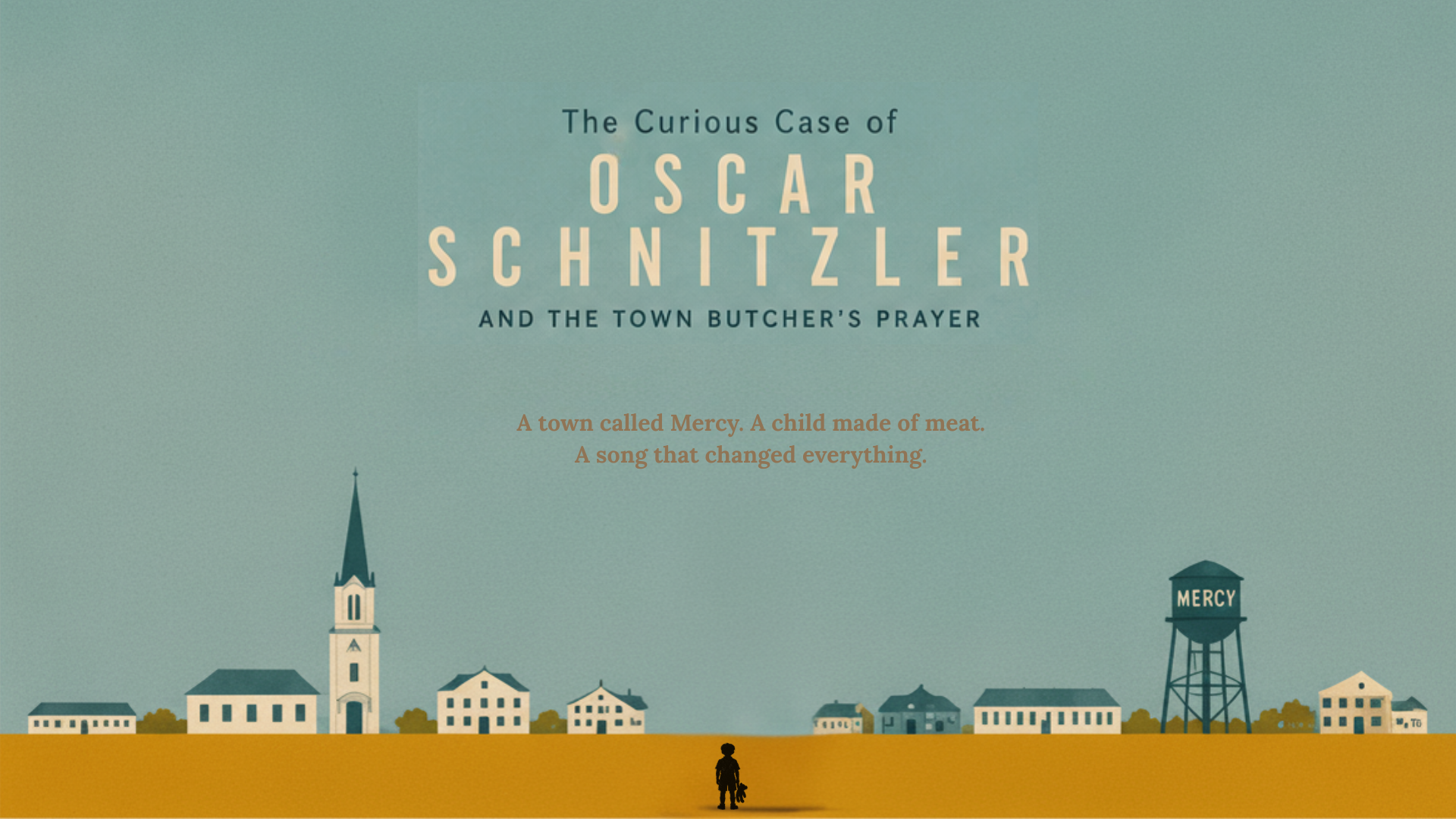
A town called Mercy. A child made of meat. A song that changed everything.